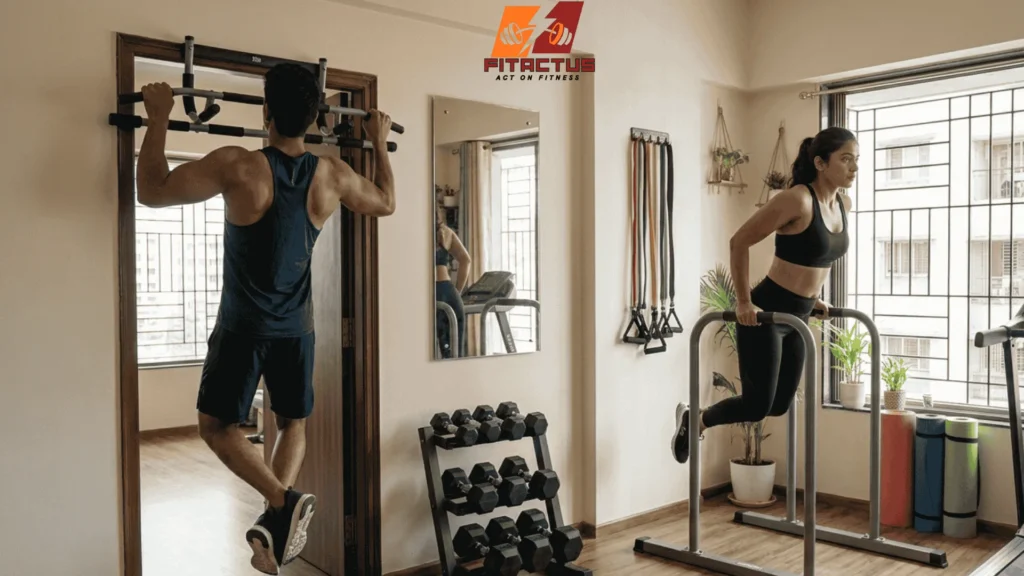
A pullup bar is one of the simplest and most effective tools you can add to your home workout setup. Whether you’re using a doorway model, a pull up bar wall mount, or a full wall mounted pull up bar at the gym, this equipment helps you build real functional strength. Pull-ups work your back, arms, shoulders, and core — and they can be done by anyone with consistent practice. If you’re new to strength training, learning how to use a pullup bar properly can transform your upper-body fitness.
This guide will help beginners understand how to use a pull-up exercise machine safely, how to progress if you can’t do a pull-up yet, and how dip bars and other equipment can complement your back training.
Why Use a Pull-Up Bar?
A pullup bar trains several major muscle groups at once, making it one of the most efficient pieces of equipment available:
- Lats and upper back
- Biceps and forearms
- Shoulders
- Core and stabilizers
- Grip strength
Unlike machines that restrict your movement, a pull-up exercise machine or bar forces your entire body to work as a unit. This builds functional strength you can use in everyday life, sports, or calisthenics training. Plus, a pull-up bar wall mount or chin up bar wall mount is compact and easy to install, making it perfect for home gyms.
Types of Pull-Up Bars
If you’re just starting, understanding the different types of bars helps you choose what fits your space and goals.
1. Doorway Pullup Bars
Great for beginners and renters. Easy to install and remove.
2. Wall Mounted Pull Up Bar
A stable, permanent option. A wall mounted pull up bar or chin up bar wall mount provides a secure grip and can support advanced movements.
3. Ceiling or Multi-Gym Bars
Often found in gyms or larger home setups. These support multiple grips and attachments.
4. Outdoor Bars
Common in parks or calisthenics spaces for bodyweight training.
Each of these supports the core pull-up movement, so choose whatever suits your home setup — especially if you’re tight on space.
How to Use a Pull-Up Bar: The Basics
1. Get Your Grip Right
Your grip makes a big difference:
- Overhand Grip (Pull-Up): Palms facing away — ideal for back engagement.
- Underhand Grip (Chin-Up): Palms facing you — slightly easier for beginners.
- Neutral Grip: Palms facing each other — available on multi-grip bars.
A chin up bar wall mount with several handle options is especially useful for beginners who need variety.
2. Engage Before You Pull
Avoid hanging loosely. Instead:
- Keep your core tight
- Pull your shoulder blades down and back
- Avoid shrugging
This “active hang” protects your shoulders and builds more strength over time.
3. Perform a Proper Pull-Up
Here’s the correct technique:
- Start in a dead hang or active hang.
- Pull your chest toward the bar by driving your elbows downward.
- Keep your body steady without swinging.
- Lift until your chin passes the bar.
- Lower slowly and with control.
Slow, controlled reps are more effective — especially for beginners.
Beginner Progressions (If You Can’t Do a Pull-Up Yet)
Most beginners start with easier variations. Here’s how to progress:
1. Dead Hangs
Hang on the pullup bar for 10–20 seconds to build grip strength.
2. Scapular Pulls
Pull your shoulder blades down while keeping your arms straight. This prepares you for proper form.
3. Assisted Pull-Ups With Bands
Loop a band around your wall mounted pull up bar or pull-up exercise machine. Place your foot or knee into it for support.
4. Negative Pull-Ups
Jump to the top position and lower slowly for 3–5 seconds. This builds the strength needed for your first full rep.
5. Chin-Ups
Using an underhand grip shifts more work to your biceps, making it easier than a traditional pull-up.
6. Australian Pull-Ups (Inverted Rows)
Use a low bar or dip bars to train your back at an easier angle.
With 2–3 sessions per week, most beginners see progress quickly.
How Dip Bars Support Pull-Up Training
While pullup bars focus on the back and biceps, dip bars work the chest, triceps, and shoulders. Together, they create a balanced upper-body routine. Many home gyms pair a pull-up bar wall mount with dip bars to cover all fundamental pushing and pulling movements. This also helps improve core strength and stability, making pull-ups easier over time.
Common Mistakes to Avoid
Beginners often struggle because of poor form or overtraining. Avoid these:
- Swinging legs or using momentum
- Shrugging shoulders during reps
- Using too wide a grip
- Doing half reps instead of full range
- Installing a pull up bar wall mount incorrectly
- Training pull-ups every single day without rest
Focus on quality over quantity for faster progress.
Training Frequency for Beginners
Start with:
- 2–3 sessions per week
- 10–20 minutes per session
Include warm-ups, hangs, negatives, and assisted reps. Pull-ups demand recovery, especially for beginners.
Final Thoughts
A pullup bar is one of the most effective tools for building back and upper-body strength. Whether you install a wall mounted pull up bar at home or use a chin up bar wall mount at the gym, the key is practicing good form and progressing gradually. Combine your pull-up training with dip bars and core exercises for a balanced, functional, and strong upper body. With consistency, even complete beginners can achieve their first pull-up — and then keep improving.