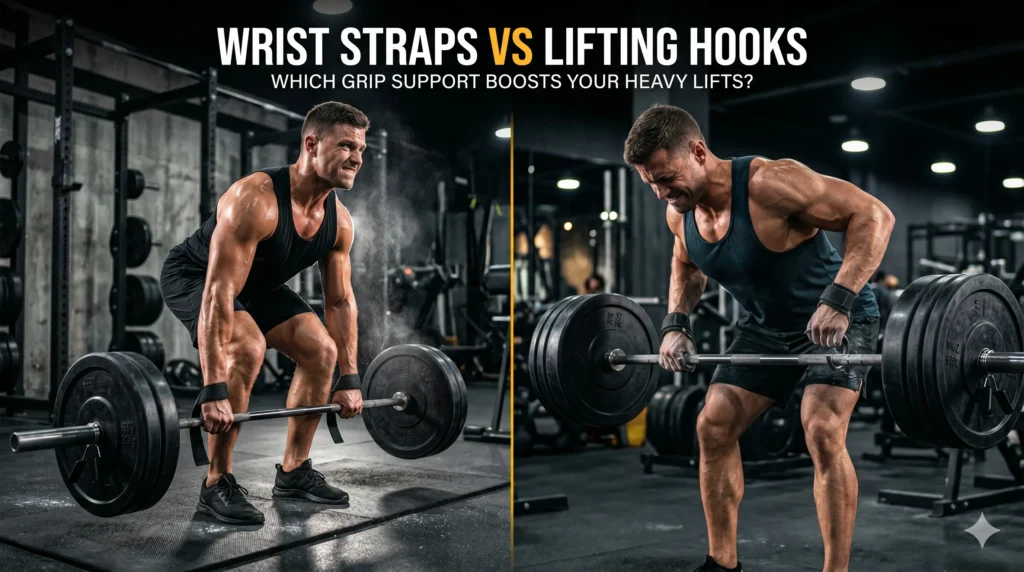
Wrist Straps vs Lifting Hooks Explained
If your grip gives out before your back, traps, or hamstrings do, you’ve probably considered using lifting accessories. The two most common options are wrist straps and lifting hooks. But which one should you choose?
Wrist straps are better for maximizing grip support during heavy pulling exercises, while lifting hooks are easier to use and reduce grip demand even more.
Wrist straps are preferred by serious lifters and powerlifters, whereas lifting hooks are often better for beginners, bodybuilding, high-volume training, or people with limited grip strength.
In this guide, we’ll break down the differences between wrist straps vs lifting hooks, including how they work, their pros and cons, and which one is best for your training goals.
Wrist Straps vs Lifting Hooks: Quick Comparison
| Feature | Wrist Straps | Lifting Hooks |
| Grip Support | High | Very High |
| Learning Curve | Moderate | Easy |
| Best For | Powerlifting, deadlifts, rows | Bodybuilding, pull-downs, high reps |
| Wrist Involvement | Wrapped around wrist and bar | Hook attaches directly to bar |
| Grip Strength Development | Better | Less grip engagement |
| Setup Speed | Slower | Faster |
| Security on Heavy Lifts | More secure | Less secure at max loads |
| Comfort | Depends on material | Usually more comfortable |
| Recommended For | Intermediate to advanced lifters | Beginners or grip-limited lifters |
What Are Wrist Straps?
Wrist straps are fabric or leather straps that wrap around your wrist and the barbell to improve grip during pulling exercises like deadlifts, rows, and shrugs.
They help keep the bar connected to your hands when your grip strength becomes the limiting factor.
Common types include:
- Cotton straps
- Nylon straps
- Figure-8 straps
- Lasso straps
- Leather straps
Wrist straps are especially popular in:
- Powerlifting
- Bodybuilding
- Strongman training
- Heavy back workouts
How Wrist Straps Work?
You loop the strap around your wrist and then wrap the loose end around the barbell or dumbbell. This creates friction and reduces the amount of grip force needed to hold the weight.
As a result, you can:
- Lift heavier
- Perform more reps
- Reduce grip fatigue
- Focus on target muscles instead of your hands
What Are Lifting Hooks?
Lifting hooks are metal or plastic hooks attached to wrist straps that latch onto the barbell, allowing you to hold heavy weights with minimal grip effort.
Unlike straps, hooks do most of the gripping work for you.
They are commonly used for:b
- Lat pulldowns
- Dumbbell rows
- Shrugs
- Machine work
- High-volume bodybuilding sessions
Lifting hooks are particularly useful for people with:
- Weak grip strength
- Hand fatigue
- Wrist pain
- Arthritis or mobility limitations
Wrist Straps vs Lifting Hooks: Key Differences
1. Grip Engagement
Wrist Straps
Wrist straps still require you to grip the bar. They simply reinforce your hold.
This means your forearms and grip muscles continue to work, although less intensely.
Lifting Hooks
Hooks significantly reduce grip involvement because the hook itself supports the load.
That makes them easier to use but less effective for maintaining grip strength over time.
2. Ease of Use
Lifting hooks are easier and faster to use than wrist straps because they simply hook onto the bar instead of wrapping around it.
Beginners often struggle to properly tighten wrist straps, especially during fast-paced workouts.
Hooks are more beginner-friendly because you:
- Slide them on
- Hook the bar
- Start lifting immediately
3. Security During Heavy Lifts
Wrist Straps Win Here
For maximal deadlifts or heavy pulls, wrist straps generally provide a more secure connection to the bar.
This is why competitive strength athletes often prefer:
- Figure-8 straps
- Heavy-duty lasso straps
Hooks can sometimes shift or lose positioning under extremely heavy loads.
4. Grip Strength Development
If your goal is long-term grip strength improvement, wrist straps are the better option.
Why?
Because you still actively squeeze the bar.
Lifting hooks bypass much of the gripping action, which can lead to:
- Less forearm activation
- Reduced grip development over time
5. Comfort and Wrist Support
Hooks often include padded wrist support, making them feel more comfortable for:
- Longer workouts
- Higher repetitions
- Older lifters
- Rehab-focused training
Some wrist straps can dig into the skin if wrapped tightly.
Pros and Cons of Wrist Straps
Pros
- Excellent for heavy lifting
- More secure on deadlifts
- Better for grip development
- Preferred by powerlifters
- Multiple strap styles available
Cons
- Takes time to learn
- Slower setup between sets
- Can feel uncomfortable initially
- Requires proper wrapping technique
Pros and Cons of Lifting Hooks
Pros
- Extremely easy to use
- Reduces grip fatigue quickly
- Comfortable for high-volume training
- Helpful for people with wrist or hand issues
- Fast transitions between exercises
Cons
- Less secure for maximal loads
- Reduces grip-strength training
- Bulkier than straps
- Limited versatility for some movements
Which Is Better for Deadlifts?
Wrist straps are generally better than lifting hooks for deadlifts because they provide a stronger and more secure grip connection during heavy pulls.
Most powerlifters and advanced strength athletes use straps for:
- Heavy deadlifts
- Rack pulls
- Romanian deadlifts
- Deficit pulls
Hooks may work for lighter or moderate deadlift training, but they are rarely the first choice for max-effort lifting.
Which Is Better for Bodybuilding?
For bodybuilding workouts, lifting hooks can actually be more convenient.
They help reduce grip fatigue so you can better focus on:
- Back activation
- Muscle contraction
- Volume training
- Time under tension
If your hands fail before your lats do during rows or pulldowns, hooks may help improve training quality.
Who Should Use Wrist Straps?
Wrist straps are best for:
- Powerlifters
- Strongman athletes
- Intermediate and advanced lifters
- Heavy deadlift training
- People wanting stronger grip endurance
Choose straps if you want:
- Maximum security
- Better performance on heavy pulls
- More long-term grip carryover
Who Should Use Lifting Hooks?
Lifting hooks are ideal for:
- Beginners
- Bodybuilders
- Older adults
- Lifters with arthritis or wrist pain
- People recovering from hand injuries
Choose hooks if you value:
- Convenience
- Comfort
- Reduced grip strain
- Faster workouts
Can You Use Both?
Absolutely.
Many lifters use:
- Wrist straps for deadlifts and heavy rows
- Hooks for accessory exercises and high-volume training
This approach gives you:
- Better grip development
- Reduced fatigue
- More flexibility in training
Common Mistakes to Avoid
Using Them Too Early
Don’t rely on straps or hooks for every set. Build natural grip strength first.
A good rule:
- Use normal grip on warm-ups
- Add support only on heavier working sets
Ignoring Grip Training
Accessories should support your training, not replace grip development completely.
Include:
- Farmer carries
- Dead hangs
- Fat-grip work
- Static holds
Choosing Comfort Over Security
Hooks may feel easier, but straps are usually safer for maximal pulling strength.
Match the accessory to your training goal.
FAQs About Wrist Straps vs Lifting Hooks
Q1) Are wrist straps better than lifting hooks?
Wrist straps are generally better for heavy lifting and grip development, while lifting hooks are better for convenience and reducing grip fatigue.
Q2) Do lifting hooks weaken grip strength?
They can if overused because they reduce the amount of gripping required during exercises.
Q3 Are wrist straps allowed in powerlifting?
Most powerlifting competitions do not allow straps during competition lifts, but many athletes use them in training.
Q4) Can beginners use wrist straps?
Yes, but beginners should first build baseline grip strength before relying heavily on straps.
Q5) Are lifting hooks good for deadlifts?
They can work for lighter deadlifts, but wrist straps are usually safer and more secure for heavy pulling.
Final Verdict: Wrist Straps vs Lifting Hooks
When comparing wrist straps vs lifting hooks, the best option depends on your training style and goals.
Choose wrist straps if you:
- Lift heavy regularly
- Want better grip carryover
- Prioritize deadlift performance
- Train for strength sports
Choose lifting hooks if you:
- Want convenience
- Train primarily for hypertrophy
- Experience grip fatigue quickly
- Need extra wrist support
For many lifters, the smartest solution is using both strategically depending on the exercise.
That way, you can protect your grip when needed without sacrificing long-term strength development.