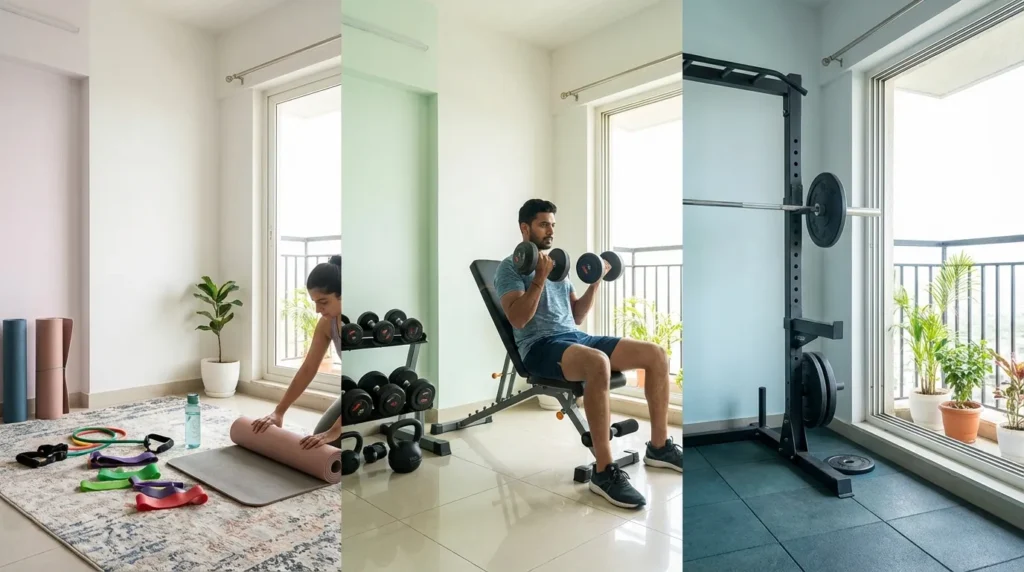
Opening a gym in India is one of the fastest-growing business opportunities, driven by rising health awareness and urban fitness culture. However, the biggest challenge is not space or marketing—it’s choosing the right gym equipment mix.
If you buy too little, your gym feels incomplete and if you overspend, your ROI suffers.
This guide solves that problem and you’ll get:
- A complete gym equipment list for India
- Cost estimates based on real market pricing
- Equipment prioritization for different budgets
- Research-backed insights on what actually drives member retention
Why Choosing the Right Gym Equipment Matters?
Gym equipment determines user experience, safety, and retention. Studies show that variety and availability of equipment significantly improve adherence to fitness programs and increase membership retention.
Research Insight
A study published in the Journal of Sports Science & Medicine (2018) found that exercise adherence improves by up to 32% when users have access to diverse equipment options. This directly impacts gym profitability.
What is the essential equipment needed to open a gym?
To open a gym in India, you need cardio machines (treadmills, bikes), strength equipment (machines and free weights), functional training tools (kettlebells, battle ropes), flooring, mirrors, lockers, and safety equipment. A basic setup costs ₹5–15 lakh, while a premium gym can exceed ₹50 lakh depending on scale and brand positioning
The complete gym equipment list for opening a gym in India includes four main categories: cardiovascular machines (treadmills, ellipticals, stationary bikes), strength training machines (lat pulldown, leg press, cable crossovers), free weights (dumbbells, barbells, weight plates), and functional fitness gear (kettlebells, resistance bands, yoga mats).
What is the Essential Gym Equipment List for India?
A commercial gym in India requires a balanced mix of treadmills, cross-trainers, multi-station gyms, power racks, dumbbell sets ranging from 2.5kg to 50kg, and Olympic barbells to serve both beginners and advanced athletes effectively.
To build a world-class facility, you must categorize your purchases. Furthermore, organizing your floor plan by these categories improves user experience.
1. Cardiovascular Equipment
Cardio machines are the most frequently used items in any commercial facility. Therefore, durability is your top priority.
- Commercial Treadmills (Minimum 4 to 6 units)
- Elliptical Cross-Trainers (Minimum 3 to 4 units)
- Stationary Upright Bikes
- Recumbent Bikes
- Rowing Machines
- Stair Climbers
Comparison Table
| Equipment | Best For | Cost (India) | Priority |
|---|---|---|---|
| Treadmill | Fat loss, walking | ₹80k – ₹3 lakh | High |
| Bike | Beginners | ₹20k – ₹1 lakh | High |
| Elliptical | Low-impact cardio | ₹60k – ₹2 lakh | Medium |
| Rower | Full-body cardio | ₹70k – ₹2.5 lakh | Medium |
2. Strength Training Machines
Machines provide safety and guided motion for beginners. Moreover, they isolate specific muscle groups effectively.
- Lat Pulldown Machine
- Seated Cable Row
- Leg Press Machine
- Leg Extension and Leg Curl Machines
- Pec Deck / Rear Delt Fly Machine
- Smith Machine
- Functional Cable Crossover Station
Research Insight
A 2020 study in Frontiers in Physiology shows that machine-based training reduces injury risk by 25–40% for beginners, making it essential for commercial gyms.
3. Free Weights and Benches
Free weights are the core of any serious fitness center. According to a study published in the Journal of Strength and Conditioning Research, training with free weights produces similar hypertrophic adaptations to machines but elicits greater increases in free testosterone, highlighting the necessity of offering both modalities in a commercial facility.
- Dumbbell Sets (Pairs from 2.5 kg up to 50 kg)
- Olympic Barbells (20 kg) and EZ Curl Bars
- Weight Plates (Ranging from 1.25 kg to 25 kg)
- Flat Benches
- Adjustable Incline/Decline Benches
- Preacher Curl Bench
- Squat Racks or Power Cages
Comparison Table
| Equipment | Use Case | Cost Range | Importance |
|---|---|---|---|
| Dumbbells | All levels | ₹100/kg approx | Critical |
| Barbells | Compound lifts | ₹5k–₹15k | Critical |
| Squat rack | Heavy training | ₹25k–₹1 lakh | High |
4. Functional and Flexibility Gear
Functional training is rapidly growing in popularity across India. In addition to traditional lifting, members expect dedicated spaces for mobility work.
- Kettlebell Sets (4 kg to 32 kg)
- Plyometric Boxes
- Resistance Bands and Tubes
- Medicine Balls and Slam Balls
- Yoga Mats and Foam Rollers
- TRX Suspension Trainers
Research Insight
According to the Journal of Strength and Conditioning Research (2019), functional training improves balance and muscular endurance more effectively than isolated machine workouts.
5. Gym Flooring and Infrastructure
What flooring is best for gyms?
Rubber flooring is best for gyms because it absorbs shock, reduces noise, and prevents injuries.
Essentials
- Rubber mats
- Mirrors
- Lockers
- Reception desk
- Air conditioning
- Sound system
6. Recovery and Safety Equipment
Safety equipment includes tools for supporting, protecting, and spotting the user during exercise to prevent accidents, while recovery equipment focuses on improving circulation, relieving muscle soreness, and enhancing mobility post-workout. Basically they are designed to prevent injuries, facilitate muscle repair, and allow for rehabilitation after intense physical exertion.
Equipment List
- Foam rollers
- Stretching mats
- First aid kits
- Ice packs
Research Insight
A study in Sports Medicine (2015) found that post-exercise recovery tools can reduce muscle soreness by up to 30%, improving member satisfaction.
How much does it cost to set up a gym in India?
A basic gym setup costs ₹5–15 lakh, while a mid-range gym costs ₹15–30 lakh, and premium gyms can exceed ₹50 lakh.
Comparison Table
| Budget | Equipment Level | Ideal For |
|---|---|---|
| ₹5–10 lakh | Basic setup | Small local gyms |
| ₹10–25 lakh | Standard commercial | Urban gyms |
| ₹25–50 lakh | Premium setup | High-end fitness clubs |
How Much Space Do You Need for Gym Equipment?
A standard commercial gym requires between 3,000 to 5,000 square feet. You must allocate roughly 40 to 50 square feet of walking space per piece of equipment to ensure member safety and comfort.
Space planning is just as important as the equipment itself. The American College of Sports Medicine (ACSM) facility standards dictate that there should be at least 36 inches of clearance around all strength training machines and free weight areas. Consequently, overcrowding your gym floor to fit more machines can lead to accidents and a poor user experience. Always prioritize safe traffic flow over equipment density.
What is the Average Cost of Gym Equipment in India?
Opening a standard 3,000 square foot commercial gym in India typically requires an equipment investment ranging from INR 15 Lakhs to INR 40 Lakhs, depending on whether you purchase imported premium brands or high-quality domestic setups.
Budgeting accurately is critical. Initially, imported brands will cost significantly more but may offer longer warranties. Conversely, several Indian manufacturers provide robust, biomechanically accurate machines at a fraction of the cost. Therefore, a hybrid approach—buying premium domestic strength equipment and imported commercial cardio machines—is a highly effective strategy for new gym owners.
What equipment should you buy first for a gym?
Start with cardio machines, basic strength equipment, and free weights before adding advanced or luxury equipment.
Priority Order
- Cardio machines
- Free weights
- Strength machines
- Functional equipment
- Accessories
Common Mistakes When Buying Gym Equipment
- Overbuying expensive machines
- Ignoring maintenance costs
- Not considering space planning
- Choosing aesthetics over usability
Frequently Asked Questions (FAQs)
Q1) What is the most essential equipment for a new gym?
The most essential items are treadmills, a functional cable crossover, an adjustable bench, and a complete set of dumbbells. These four items allow users to perform a full-body workout safely.
Q2) Should I lease or buy gym equipment in India?
If you have the capital, buying equipment outright is more profitable long-term. However, leasing cardio equipment is a viable option because it allows you to upgrade expensive, technology-heavy machines every few years without massive capital expenditure.
Q3) How often should commercial gym equipment be serviced?
Commercial gym equipment should undergo preventative maintenance every month. Cables, treadmill belts, and upholstery should be inspected weekly to prevent injuries and extend the lifespan of the assets.
Q4) Can I open a gym with only free weights?
Yes, this is known as a “black iron” or boutique powerlifting gym. However, to appeal to the general public and maximize your membership base in India, a mix of cardio, machines, and free weights is highly recommended.
Q5) What is the minimum equipment needed to open a gym?
You need treadmills, dumbbells, barbells, benches, and at least 3–5 strength machines.
Q6) Which gym equipment gives the best ROI?
Treadmills and dumbbells provide the highest ROI because they are used by most members daily.
Q7) Is it better to buy new or used gym equipment?
New equipment ensures durability and warranty, but refurbished equipment can reduce initial investment by 30–50%.
Q8) How much space is required for a gym in India?
A small gym needs at least 800–1500 sq. ft., while a full gym requires 3000+ sq. ft.
Q9) What licenses are required to open a gym in India?
You need a trade license, GST registration, and local municipal approvals.
Conclusion
Choosing the right gym equipment is not about buying everything—it’s about buying what your customers will actually use.
A smart mix of:
- Cardio machines
- Strength equipment
- Free weights
- Functional tools
…will maximize both member satisfaction and profits.